Newsletter Subscribe
Enter your email address below and subscribe to our newsletter

Enter your email address below and subscribe to our newsletter

and more frequent access to space. For Africa, the theme raises a practical question. The continent builds more satellites every year, but it still launches none of them itself. Satellite internet is spreading fast, yet South Africa remains one of its biggest gaps. All figures are converted at about R16.50 to the US dollar.
The United Nations declared World Space Week in 1999. It runs from 4 to 10 October every year. The 2026 theme, Rocket Revolution, looked at how new launch technology changes who can reach space and how often.
Africa feels this shift as a customer. Algeria launched ALSAT-3A and ALSAT-3B in January 2026. That brought the number of satellites launched by African countries to 69 since Egypt’s NileSat-101 in 1998. Eighteen countries have now placed satellites in orbit. Egypt and South Africa lead with 15 and 12. All of these satellites went up on rockets from Japan, Russia, China, the United States or Europe.
Nigeria wants to change that. The country launched its first communication satellite in 2007. Its space agency now says the president has approved six new satellites, two for communications and four for Earth observation. A rocketry and permanent launch site programme has also been approved.
| 📌 Indicator | 🔢 2026 Status |
|---|---|
| Satellites launched by African countries | 69 since 1998 |
| Countries with satellites in orbit | 18 |
| Leading nations | Egypt (15), South Africa (12) |
| New African satellites projected for 2026 | At least 8 |
| Operational launch sites in Africa | None |
The African Space Agency (AfSA) is based in Cairo and was officially inaugurated in 2025. It coordinates space policy across the African Union and pools resources. Its work rests on four pillars: Earth observation, satellite communication and navigation, astronomy and space science.
Government spending is rising. African governments budgeted about R13.7bn for space in 2026, according to Space in Africa. That is up from about R10.3bn the year before. The total includes African Union funding for the agency.
Budgets often go to a single flagship project. Angola spends about 96.7% of its space budget on the ANGEO-1 satellite programme. Space in Africa expects at least eight new African satellites to launch in 2026 if plans hold. African satellites already track crop health, water resources, floods and droughts. They can also support disaster response across the continent.
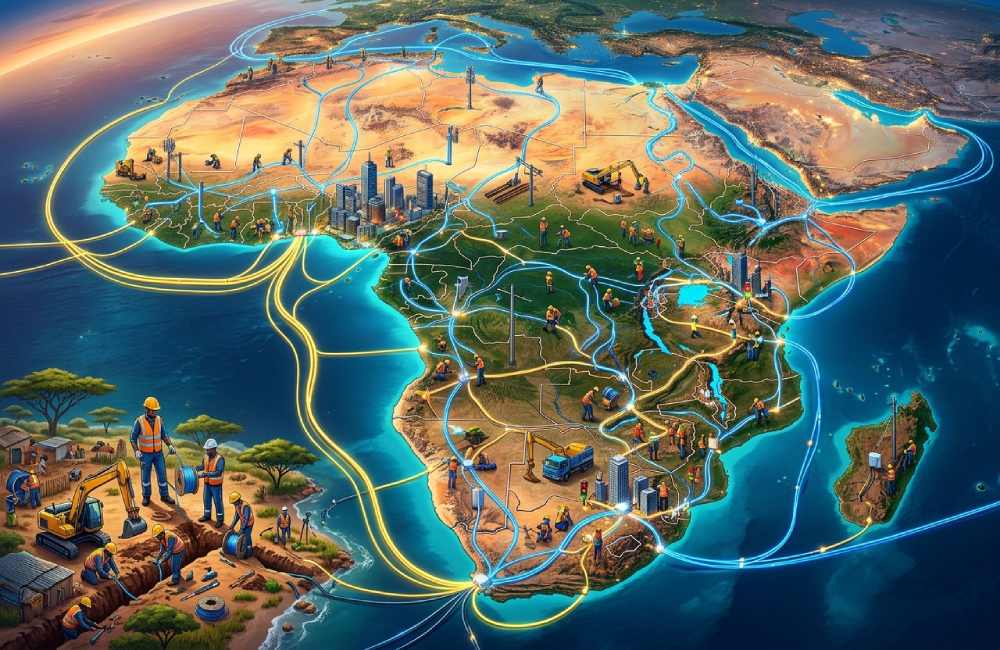
Satellite internet in Africa has grown faster than any national space programme. Access now depends more on national regulation than on technical coverage. Three developments stand out in 2026:
Speed is a selling point. Ookla data showed Starlink beating local providers in almost every African market it measured in early 2026. Business-grade low-Earth orbit services already exist in South Africa. SEACOM launched an enterprise LEO satellite service in 2024.
Starlink South Africa is still not licensed. In June 2026, ICASA confirmed it had received no licence applications from Starlink. The obstacle is the rule that network licence holders must be at least 30% owned by historically disadvantaged groups.
Communications Minister Solly Malatsi wants equity-equivalent investment programmes to count instead. ICASA has said that full alignment with this approach would require an amendment to the Electronic Communications Act. Starlink has offered to invest at least R500M in free broadband for 5,000 schools if the rules change.
Amazon has taken a different route. Amazon Leo signed a deal with Herotel, South Africa’s largest fixed internet provider. Herotel’s new evry service is due to launch commercially for homes in 2027. Because Herotel holds the licence, the ownership rule does not block Amazon. Amazon also plans direct-to-device satellite services in South Africa from around 2028.
World Space Week celebrated cheaper rockets. Africa benefits from that trend as a buyer of launches, not yet as a launcher. Nigeria’s launch site plans could change this, but the programme is still at an early stage. For satellite internet in Africa, the main constraint is now regulation, not technology. If you live outside the metros in South Africa, the planned Herotel service is the main confirmed home option so far. Watch ICASA’s next steps on Starlink.