Newsletter Subscribe
Enter your email address below and subscribe to our newsletter
Enter your email address below and subscribe to our newsletter
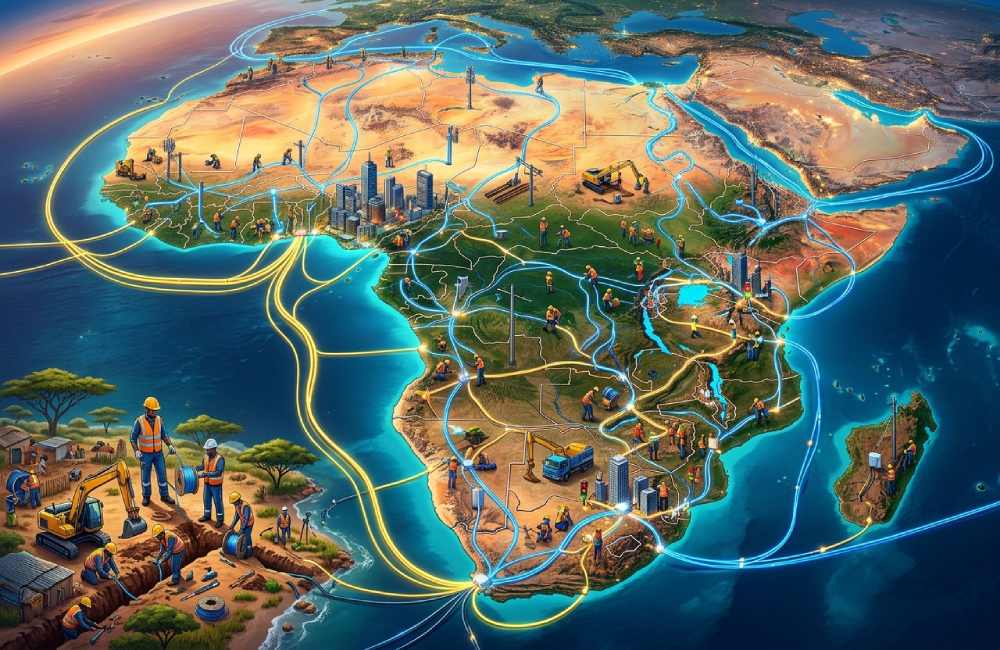
Mid-September 2026 brought a burst of money for African networks. On 16 September, the US International Development Finance Corporation (DFC) pledged up to R2.48bn to WIOCC. Days earlier, the US Export-Import Bank approved a R1.59bn loan to Africell. For the Africa internet market, that is a clear signal.
Together with local and multilateral deals, these commitments show who is financing Africa’s fibre build-out. Data centres, cloud services and AI all depend on fast fibre links, which barely exist outside the big cities. Below, we look at where the money comes from and what it still cannot fix.
The biggest cheque went to WIOCC. The Johannesburg-headquartered group runs fibre networks and data centres in more than 30 countries. The money will also support the subsea cables that link the continent to the rest of the world. According to TechCentral and Reuters, the DFC describes the deal as its largest equity investment ever.
WIOCC had already raised R4.8bn two weeks earlier from the Africa Finance Corporation and Saudi investor Vision Invest. As equity investors, these backers now own part of the company and expect a share of future profits. Deals of this size are not new in the region, as the Vodacom and Maziv fibre deal showed in December 2025. The table below gives an overview of the largest recent commitments.
| 🏦 Backer | 📄 Type | 💰 Amount | 📍 Recipient |
|---|---|---|---|
| DFC (USA) | Equity | up to R2.48bn | WIOCC |
| AFC and Vision Invest | Equity | R4.8bn | WIOCC |
| US ExIm Bank | Loan | R1.59bn | Africell |
| DNI consortium | Equity | R1.58bn | Frogfoot and Vox |
Washington’s motive is openly strategic. The DFC says the deal supports US hyperscalers and trusted networks, a term aimed at Chinese vendors such as Huawei. Whoever builds the backbone for Africa internet access today decides whose technology runs on it tomorrow. The Africell loan follows the same logic. It pays for US and European mobile equipment, mainly in Angola, rather than fibre.
Townships are the next step because the suburbs are largely connected. South Africa has about 4.5 million fibre-connected homes, and almost all of them are in higher-income areas. The remaining growth for fibre internet in South Africa now lies in lower-income communities.
That pattern goes back to 2014. Back then, Vumatel wired the Johannesburg suburb of Parkhurst and started the first wave of home fibre in the country. Vumatel fibre internet in South Africa became the model for every suburban rollout that followed.
The economics have changed since then. Build costs have fallen and operators have cut their wholesale prices. As a result, broadband internet in South Africa is now affordable for households that could never pay suburban rates.
This is where local capital comes in. On 1 September, a consortium around the investment firm DNI paid R1.6bn for 34.8% of Frogfoot Networks and Vox Telecom. The billionaires Stephen Saad and Mike Teke are shareholders in DNI. Vox is one of the larger internet providers in South Africa, so the new owners gain direct access to customers.
The ambition is clear: Frogfoot wants to connect about 360,000 homes a year, as the R14.4bn valuation deal revealed in August. Still, the combined business lost R256M last year. You should read the deal as a long-term wager, not a quick win.
Governments and development banks fund the long national backbones that private investors avoid. Their goal is to raise internet penetration in Africa, which still lags far behind the rest of the world. According to the ITU, only 36 per cent of people in Africa used the internet in 2025. Worldwide, the figure was 74 per cent.
Two projects show the scale of what is planned:
| 🌍 Country | 🏗️ Project | 💰 Funding | 🎯 Target |
|---|---|---|---|
| Kenya | National and cross-border fibre tender | R6.24bn in World Bank credits | 100,000 km of national fibre |
| Nigeria | Project BRIDGE | About R32bn incl. World Bank and AfDB | 90,000 km of open-access fibre by 2030 |
Kenya’s tender closes on 29 October 2026, as TechAfrica News reports. Nigeria plans to start construction in 2027. Both projects are open to private builders and operators. The public money is meant to pull in private capital later.
Money alone does not lay cable. Builders across the continent face the same hurdles:
Together, these hurdles slow the final stretch of cable to people’s homes, especially in villages. In many rural areas, fibre is still years away. Until it arrives, satellite links are often the fastest option. Several providers already offer them in many countries. Speeds also vary widely from country to country, as our ranking of the fastest internet in Africa shows.
The short answer is everyone, eventually. The DFC, AFC and Vision Invest want returns on their equity. Development banks want their loans repaid. These repayments flow back through wholesale prices, retail tariffs and public budgets.
So customers and taxpayers carry the final bill for better Africa internet access. Whether the investments close the gap depends on where the cables go next. Watch Kenya’s tender in October and Nigeria’s financing round for BRIDGE. If faster internet is the payoff, rural areas must share in it.