Newsletter Subscribe
Enter your email address below and subscribe to our newsletter

Enter your email address below and subscribe to our newsletter
Dentistry has changed a lot over the past 25 years. Many dentists have moved away from traditional, hands-on methods and towards digital tools that are more precise, less invasive, and often far more comfortable for patients. These advances aren’t just about new technology; they’re about making visits to the dentist a better experience overall.
At first glance, teeth might seem like a small part of our overall health. But they play a role in many of the things we do. They help us enjoy a wide range of foods, pronounce words clearly, and express emotion through facial movement.
Whether we’re talking with friends, meeting someone new, or simply going about our day, teeth are part of how we communicate and interact. Their impact is subtle, but constant, shaping daily experiences in ways that are easy to overlook.
All of this helps explain why oral health matters to us at Align Technology. When we experience discomfort or notice a change with our teeth, most people instinctively seek out a dentist or orthodontic specialist, rather than a general practitioner.
When it comes to our mouths, we demand specialist expertise.
It’s clear to see how the technologies employed by dentists and orthodontists have advanced over the years. Perhaps less well known, however, are the myriad delivery-related developments we have witnessed during recent years, especially within the field of digital dentistry.
Any time an examination, diagnosis, treatment or procedure is conducted using computerised tools, it falls under the banner of digital dentistry. This is distinct from conventional dentistry, which relies on the manual and electrical devices to which most of us are accustomed.
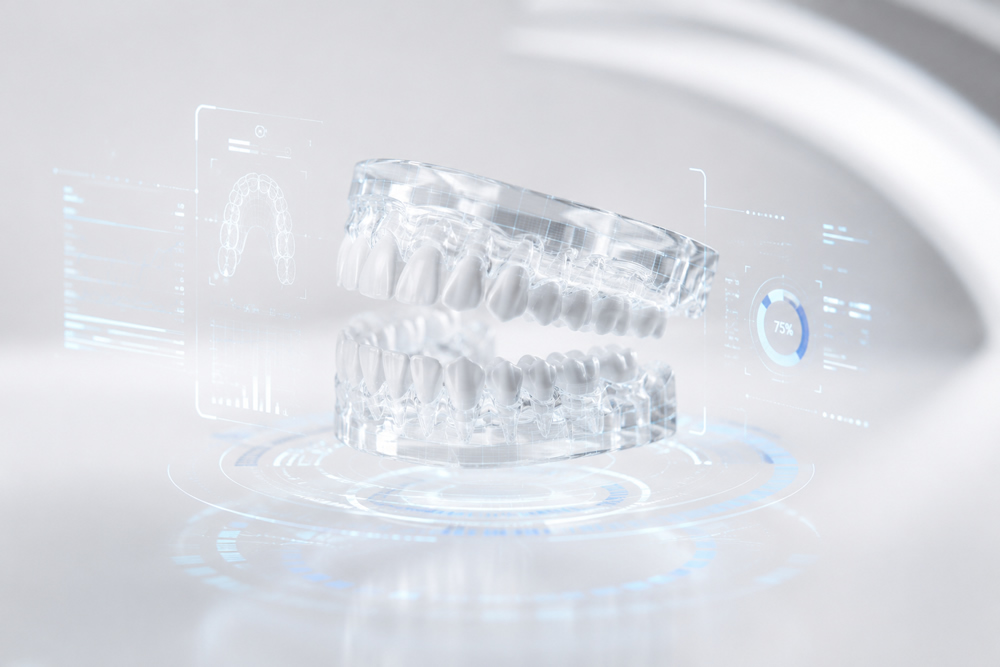
Clear aligners represent one such advancement. Thanks to technologies such as 3D manufacturing, dentists and orthodontists are now able to create bespoke aligners more efficiently and cost-effectively than ever before. Tech-savvy and custom-made alternative to traditional teeth-straightening solutions such as wires and brackets – clear aligners – are removable, transparent and can be used to treat minor to complex types of malocclusions. Great news for patients and dentists alike.
The use of digital dentistry is increasing globally tand steadily increasing in South Africa. Within the next five to seven years, the dental device market is poised for robust expansion at a compound annual growth rate of 6.60%. Around 70% of specialists in Johannesburg, Cape Town and Durban now use digital dentistry tools for case planning, a proportion that has increased fourfold since 2020. To meet growing market demand and advance access to digital dentistry technology, companies such as Align Technology are strengthening their presence in South Africa to enhance support for doctors and their patients. This includes the launch of innovative dental devices and platforms such as the Invisalign® System, iTero™ scanners, and exocad™ software.
More and more, we are seeing how enhanced workflow and scanning capabilities are enabling digital dentistry practitioners to help more patients in less time, and deliver world-class treatment.
The intraoral scanner is another digital dentistry tool whose popularity is on the rise. Capable of scanning patients’ mouths with great accuracy, these devices generate digital impressions which can be used to create crowns, inlays, and aligners. For us, at Align Technology, we see that technology such as the iTero Lumina Intraoral scanner, a next-generation digital dental scanner, enables fast, accurate 3D scanning with superior workflow efficiency and an improved patient experience. It uses precise imaging technology facilitated by optical and laser scanners. With applications for both orthodontic and restorative dentistry practices. It’s technology like this that enable practitioners to track incremental changes in patients’ teeth over extended periods.
While there are many other examples of innovative digital dentistry tools, advancements within this field share a common theme: by and large, they help doctors deliver a more precise, efficient, and comfortable patient experience, while saving all stakeholders time -.
This is the foundation upon which digital dentistry was built: to help dentists and orthodontists grow and expand their practices through the provision of digital tools that make their work more efficient and provide excellent quality for patients.
Of course, while the technologies outlined above have all been developed primarily with a view to improving the quality of oral healthcare, they also offer the added benefit of convenience. In my view, the fact that progress within teledentistry – and especially the discipline of digital dentistry – has accelerated more rapidly during recent years is no accident.
For a country such as South Africa, these technology-based solutions are especially critical. Millions of South Africans are suffering from oral health conditions, starting at a young age. Statistics show that 41% of South African children aged 1-9 years and close to 28% of people aged 5 years and over experienced untreated tooth decay in deciduous and permanent teeth respectively, while nearly 25% of people aged 15 years and over experienced severe periodontal disease (Source: The South African Dental Association).
In short, South African dentists and orthodontists will increasingly be able to raise oral health standards among their patients while reducing the need for them to attend in-person consultations, thanks to the latest digital tools. That’s not to say digital technology will bypass the role of the specialist – on the contrary. Every orthodontic treatment requires presence of dentist or orthodontist to be performed safely and bring the expected outcomes.
Indeed, progress within this segment may have been brisk during recent years, but doctor-led teledentistry has not yet expanded to the point where it represents the norm.
For me, this is the main takeaway: digital dentistry empowers doctors to raise quality standards and deliver greater convenience through doctor-led remote treatments. These advanced tools are entirely in the hands of clinicians, enhancing their expertise in ways conventional methods simply cannot match. Practices that hesitate to adopt these technologies risk losing both patients and revenue.
Ultimately, we may have a way to go before teledentistry achieves widespread adoption, but the direction of travel is clear to see.
Make no mistake, digital dentistry is the future of our sector.
Angelo Maura, General Manager – Middle East and Africa, Align Technology