Newsletter Subscribe
Enter your email address below and subscribe to our newsletter

Enter your email address below and subscribe to our newsletter
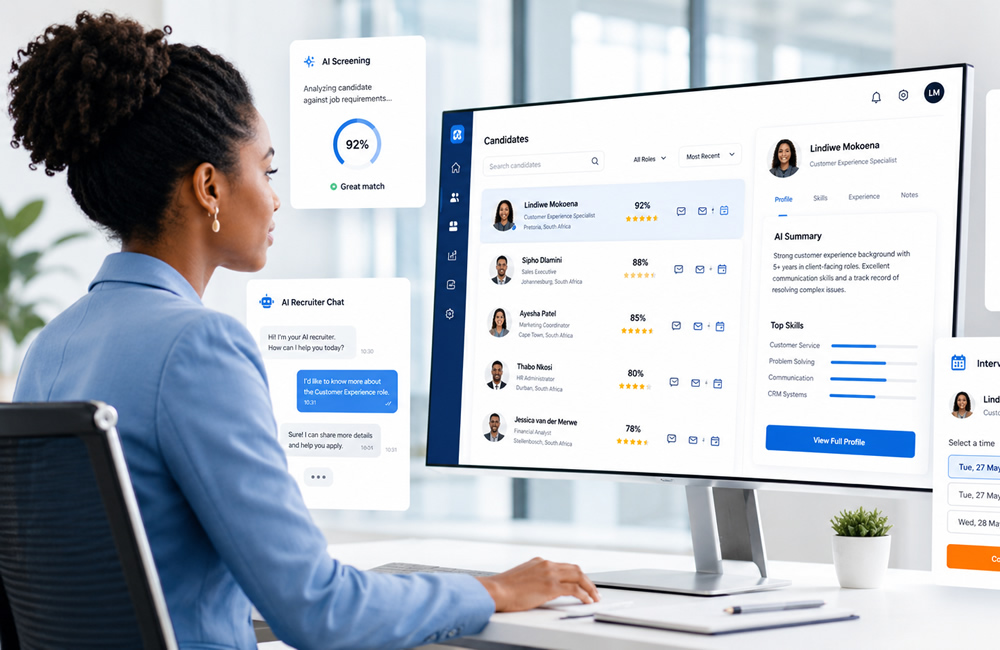
South Africa’s hiring teams are wrestling with a volume problem that traditional processes were never built to handle. A single retail or call-centre campaign can attract a few thousand applicants in a week, and manual CV review stretches time-to-fill from days into weeks. By the time a shortlist lands, the strongest candidates have usually accepted offers elsewhere.
That pressure has pushed AI recruitment from an experiment into core infrastructure for local enterprises. The strategic question in 2026 is no longer whether to adopt it, but how to deploy it without losing control of governance.
The market has also matured past the idea that “AI” is a single thing. In practice, two distinct tools sit under the same umbrella, and they carry very different risk profiles.
The first is the recruitment chatbot, a scripted and guard-railed conversational interface that runs on a fixed flow. It is predictable by design, which makes it ideal for high-volume, repeatable work such as applying, screening, scheduling and answering candidate questions. For frontline and seasonal hiring, where mobile-first applicants expect to apply over WhatsApp rather than an email portal, chatbots have quietly cut vacancy times by up to half.
The second is the AI agent, a goal-driven system that plans and executes multi-step tasks to reach an outcome, such as building a compliant shortlist. Agents offer far higher leverage across sourcing and market mapping, but their autonomy is exactly why human oversight matters. Independent testing has shown the gap between a polished sourcing demo and live recruiting reality remains wide, and unchecked outreach can drift into POPIA and scraping grey areas.
Governance is where the local context bites hardest. Any platform operating here has to process candidate data lawfully, capture consent, apply role-based access and keep audit-ready records, all while supporting Employment Equity reporting and B-BBEE obligations. Compliance cannot be bolted on at the end. It has to be built into the workflow.
That is the thinking behind enterprise platforms such as graylink, which pairs a next-generation applicant tracking system with conversational tools and agentic capabilities aimed at the South African market. The logic is simple: keep the ATS as the single system of record, run intelligence through every stage of the funnel, and treat POPIA, EE and bias auditing as product requirements rather than policy slides.
The business case is what convinces finance teams. Done properly, automation compresses days of admin into minutes, reduces reliance on external headhunters and paid job boards, and lifts the quality of initial matches through predictive analytics. Most enterprises report measurable returns within two quarters, driven less by headline savings and more by the compounding effect of faster pipelines and a better candidate experience.
None of this means recruiters are being replaced. When agents absorb scheduling, screening admin and pipeline hygiene, the work left over is the work that actually closes hires: calibration with hiring managers, relationship building and the judgement calls on borderline candidates. The teams pulling ahead are not the ones with the most technology. They are the ones using it to spend more time being human.
For organisations weighing their next move, the practical starting point is to map which roles need scale, which need autonomous sourcing, and where compliance risk is highest, then choose tooling to match.
//Staff writer