Newsletter Subscribe
Enter your email address below and subscribe to our newsletter

Enter your email address below and subscribe to our newsletter
Bootstrapped companies operate under a constraint that funded competitors do not face: every hour of operational overhead is an hour that cannot be spent on the work that generates revenue. The funded competitor can hire an operations team to manage their tool stack, a project coordinator to maintain their tracking systems, and an IT team to administer their infrastructure. The bootstrapped company has the founders and the first hires, and those people are either making the product, selling the product, or keeping the organization running, often all three simultaneously. The companies that bootstrap their way to scale without running out of operational capacity before they reach profitability have done it by building an operational infrastructure that handles the coordination overhead automatically, so the small team can stay focused on the high-value work rather than spending its limited hours on the administrative work that larger teams offload to dedicated roles. That infrastructure is built on project management tools designed to deliver operational discipline without operational overhead.
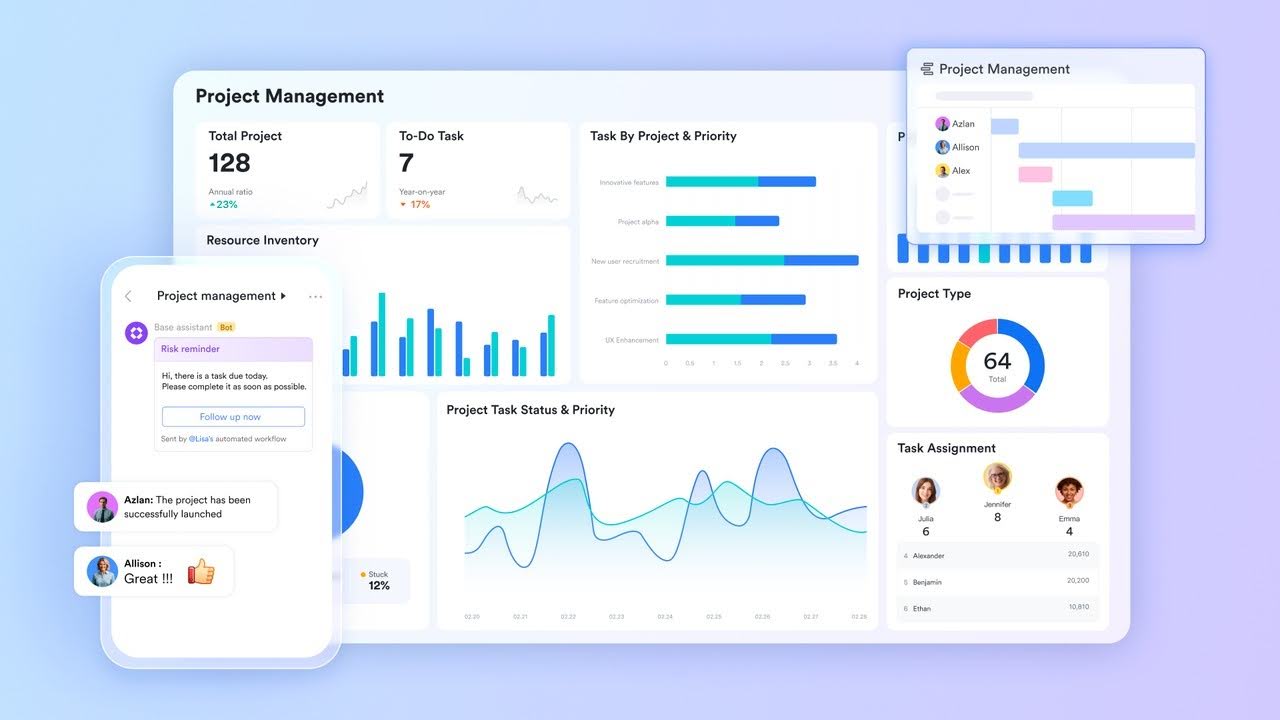
The bootstrapped team that cannot afford a dedicated project manager needs a project tracking system that does not require a project manager to maintain it. Lark Base gives small teams a relational database that updates itself through automation workflows and surfaces exceptions through automated notifications, so the tracking system reflects the current state of the team’s work without anyone having to manage it manually.
The bootstrapped company that receives requests through email, chat, and verbal conversation is paying an invisible operational tax every time a founder has to sort, interpret, and manually process an incoming request that should have arrived in a structured format ready for action. Lark Forms eliminates that tax.
Bootstrapped companies tend to have poor documentation not because the team does not understand the value of documentation, but because the time required to maintain separate documentation is a luxury the team cannot afford. When documentation is a natural byproduct of the work rather than a separate activity, bootstrapped teams document by default rather than by effort.
The bootstrapped team’s communication environment needs to be fast enough for real-time coordination, structured enough to prevent important information from being buried, and efficient enough that managing communication does not become a full-time job. Most communication tools optimize for one of those three requirements and compromise on the other two.
The bootstrapped team that holds a weekly alignment meeting is a bootstrapped team that spends a significant fraction of its available working time on alignment infrastructure rather than on the work that the alignment is supposed to support. Lark OKR creates alignment as a structural property of the goal system rather than as an outcome of weekly meetings.
Bootstrapped companies that have been highly efficient at small scale often become inefficient exactly as they achieve the growth they were working toward, because the operational infrastructure that served them at ten people cannot serve them at fifty. The informal coordination that worked when everyone was in one room stops working when the team is distributed. The shared spreadsheet that tracked everything breaks when thirty people are editing it. The email thread that manages all the intake becomes unmanageable when the volume triples.
The tools that most bootstrapped companies use to solve these problems, Trello or Asana for task management, Notion for documentation, and Slack for communication, each solve one problem while adding another tool to the stack. Looking at Google Workspace pricing as a foundation and adding those specialist tools on top creates a system that a bootstrapped team at ten people can just manage and a bootstrapped team at fifty people cannot manage without dedicated operational staff. Lark handles every category of operational need in one environment, so the operational infrastructure that works at ten people still works at fifty without requiring the operational staff that would undermine the bootstrapped company’s cost advantage.
Bootstrapped companies punch above their weight when their operational infrastructure is efficient enough that every person on the team spends the majority of their time on high-value work rather than on the coordination overhead that less efficient infrastructure generates. A connected set of productivity tools that handles project tracking, intake, documentation, communication, and goal alignment without requiring dedicated roles to maintain any of them is how bootstrapped companies stay lean enough to outperform funded competitors with ten times their headcount.