Newsletter Subscribe
Enter your email address below and subscribe to our newsletter

Enter your email address below and subscribe to our newsletter
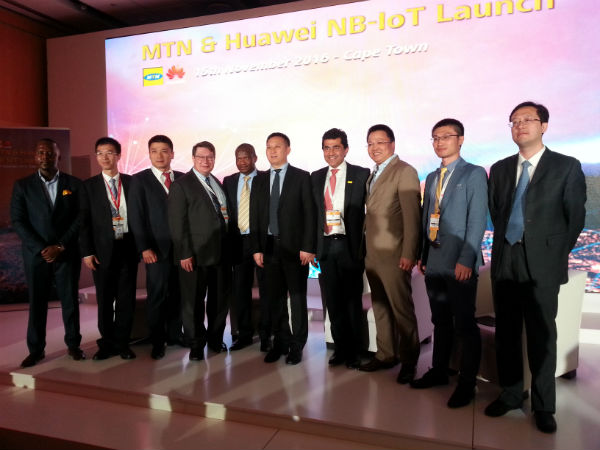

MTN and Huawei Technologies partnered at AfricaCom to conduct live demonstrations of Narrowband Internet of Things NB-IoT focused on Smart Refrigirator, Smart water metering and User-based Insurance solutions. The event is underway from the 15th -17th November 2016 at the CTICC in Cape Town South Africa.
NB-IoT is a Low Power Wide Area Network (LPWAN) radio technology standard that has been developed to enable a wide range of devices and services to be connected using cellular telecommunications bands. This new technology will extend the utilization of IoT by making it more efficient to connect objects requiring a long battery life and are located in remote or submerged locations. Connecting these devices to the internet by means of a mobile network is where NB-IoT comes into its own. This Low Power Wide Area technology will connect more objects to the Internet of Things as a result of a stronger and more penetrative signal.
“ IoT is an area of focus for MTN not just in South Africa but the rest of Africa. We are projecting that by 2020 over 200 billion devices would have been connected” says Alpheus Mangale who is the Chief Enterprise Business Officer for MTN South Africa .
He went on to say “without NB-IoT this means it would put a heavy load on the network infrastructure because all these devices will be generating communication services and anything that they are monitoring and after a number of trials, NB-IoT has proved to be the best technology for LPWAN Market”
The mobile industry has driven the evolution of connectivity on the African continent. Currently with any electronic device, one needs constant charging for power, but one advantage with NB-IoT services is that available devices will be placed underground or anywhere else over a period of 10 years without alterations or chargers so that they continue to function.
Another advantage is the reach of this low power low cost technology, signals will now reach remote areas unlike in the past. A case in point is when operations in the mining sector, normally done in remote regions are monitored.
Also speaking at the demo, was Michael Ma, Huawei’s President of Cloud Core product line said “I am pleased to announce the strategic cooperation with MTN in the IoT field and the partnership was showcasing solutions based on their Ocean Connect IoT platform and partner ecosystem and NB-IoT wireless technology which enables MTN to develop vertical industry applications for Usage Based Insurance, Smart Refrigeration for commercial bottling market, and smart Water Metering and looked forward to bringing more IoT services to Africa.”
It is projected that there will be about 450 000 000 cellular IoT connections by 2020. NB-IoT will cost as little as $5 per module. It can connect 100 000 devices per cell. With its vision to create an intelligent Africa, MTN’s partnership with Huawei is to provide intelligent services for government, enterprise, smart meter, smart parking, wildlife tracking, smart fridge, smart farm and smart home.
This partnership identified a new market opportunity for commercial refrigeration monitoring at point-of-sales for large bottling companies and they have developed a leading solution for the bottling and beverage industry.
Connected car is another hot topic of IoT, and is a major growth area and disruptive innovation in the motor industry. With this there was a need to provide a Vehicle Usage Based Insurance (UBI) Solution to be rolled out first in South Africa.
UBI allows insurance companies to have a driver’s driving information including location, driving behaviour and vehicle running status, and using big data technology to analyze and score the drivers’ performance on the road.The insurer can adjust their offering to be optimized to each driver.
Good driving can be rewarded, and risky or dangerous driving can be identified. In this way, insurance companies will benefit from less loss rate, and drivers will have better driving skills as well as mindset, so the motor insurance industry will be healthier.
Deployment of this strategy begins in South Africa in 2017 followed by Nigeria, Iran, Ghana in 2018 and Cameroon, Ivory Coast, Sudan, Uganda and Zambia in 2019.
By Vardis Banga